
Faculty
Services and Resources
Services
The Center for Teaching Excellence provides pedagogical support and development for faculty of all titles and ranks. Additionally, the Center partners with colleges, departments, and programs to design and facilitate world class academic programs and celebrate teaching excellence in all of its forms.
Resources
Consultations The Center offers consultations on a wide range of topics for both individuals and groups. Our team of Instructional Consultants has extensive knowledge of the scholarly literature on teaching and learning including course and curriculum design, teaching methods, active learning, student engagement, technology for teaching, and assessment.
Explore our guides for a curated selection of tools and insights designed to enhance your teaching at Texas A&M University.
Learning Design
Course Design
Effective course design can help streamline and facilitate student learning processes and ensure that a course runs smoothly throughout a semester. It can also help reduce student confusion and frustration, clarify expectations regarding assignments and tests, and maximize student learning by aligning three important teaching principles--learning outcomes, assessments, and instructional strategies. During the course design process, it is also important to consider other issues such as timing, logistics, and situational constraints. Backward design or beginning with the end in mind methods are useful in that they are student-centered design approaches focusing on student learning. Universal design principles help ensure that courses facilitate the learning of all learners, take student diversity into account, and fully include students with disabilities.
Resources:
Course Design Cycle
Universal Design
10 Simple Steps towards Universal Design of Online Courses
Guidelines of Assignment of UG Course Levels
CTE Course Level and Hours Policy Information
Learning Outcomes Module
Ensuring Digital Content is Accessible to Students with Disabilities
The Course Design Series Video
Student Learning Experience Guide

Program (Re)Design
The Center for Teaching Excellence developed the Program (Re)Design (PRD) model, a faculty-led, data-informed process aimed to assist academic programs in creating a more learner-centered curriculum. The collaborative process uses an iterative and customizable 8-step model to encourage systematic redesign that fosters critical dialogue and collegiality among curricular change stakeholders. We invite you to learn more about the PRD model and implementation at Texas A&M University.
Transformative Doctoral Education Model
The new Transformative Doctoral Education Model (TDEM) offers a fresh approach for doctoral education. Envisioned to guide all aspects of graduate student development, TDEM presses beyond the traditional apprenticeships of doctoral education by intentionally augmenting technical development with transferable skill building and career planning. The goal is to transform the student into a multidimensional scholar rooted in empirically-based knowledge that is also adept at processing complex information to adapt to new challenges. The model is customizable and flexible across institutions, disciplines, and learners.
Given the key challenges of current doctoral education, such as high attrition, long time to degree, ill-suited training, and underdeveloped skills, Texas A&M’s Center for Teaching Excellence developed the Transformative Doctoral Education Model (TDEM) after a thorough review of relevant literature as well as experiences with a NSF-NRT interdisciplinary training grant. The foundation of TDEM is transformative learning theory, supporting the notion that learner transformation occurs throughout the educational experience. Utilizing this pedagogy, TDEM promotes interdisciplinarity and transferable skills acquisition in graduate education to address current societal needs. Specifically, TDEM identifies the four higher education units as the institution, program, mentors, and doctoral student. The eight elements are considered critical to doctoral education. The overarching goal of TDEM is to transform the doctoral student into a multidimensional, adaptive scholar, so that the students of today can effectively and meaningfully solve the problems of tomorrow.
Learn more about the TDEM on our YouTube channel.

Graduate Education Model (GEM)
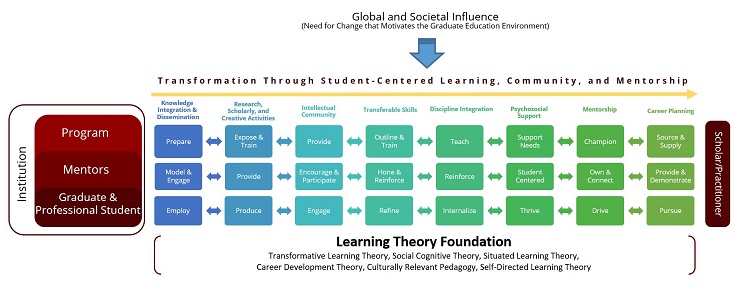
By iteratively interrogating TDEM and re-conceptualizing the model to be more inclusive for graduate education, this collaborative and innovative work will ultimately create the opportunity for a rigorous empirical evaluation of the model’s customizable design and utility that could inform and impact the broader graduate education field. Therefore, this emerging and dichotomous perspective initiated our ongoing collaboration and interrogation of TDEM so as to consider a new model; one that is more wholly inclusive of today’s graduate education landscape -- Graduate Education Model (GEM).
Through intentional and emergent collaboration with the Graduate and Professional School in spring and summer 2021, the Center for Teaching Excellence began to reconceptualize the Transformative Doctoral Education Model (TDEM). Specifically, TDEM is designed for doctoral education and therefore limiting in how inclusive the model is for the wider graduate education environment. To this end, we collectively continued to iterate TDEM and ultimately developed the Graduate Education Model (GEM).
Notable iterations:
- TDEM internal driver “Doctoral Student” becomes “Graduate & Professional Student”
- Transformative Learning (TDEM) is described as “Transformation Through Student-Centered Learning, Community, and Mentorship”
- GEM maintains a learning theory foundation (TDEM), but is conceptualized to consider meaningful connection with theories beyond Transformative Learning Theory
- Research (TDEM) is expanded to include “Research, Scholarly, and Creative Activities”
- Interdisciplinarity (TDEM) is replaced with “Discipline integration” to more fully express boundary spanning
- Stewardship (TDEM) replaced with “Psychosocial Support” to explicitly emphasize and address emergent concerns in graduate education
- Doctoral Scholar (TDEM) is extended to include “Scholar/Practitioner”
WPI IDeaS Guide to Capacity Building
Capacity building is an underutilized tool for teams working toward systemic change. Worcester Polytechnic Institute, as part of a National Science Foundation (NSF) Improving Undergraduate STEM Education (IUSE) grant, created the WPI IDeaS Guide to Capacity Building in connection with using Problem Based Learning (PBL) to transform STEM education. The model supports active engagement of team members in institutional change efforts through the principles, planning, and doing of capacity building (CTE is a partner on the grant supporting sustainability of outcomes).
Learn more about at WPI's Capacity Building Guide website.
The Digital Classroom
For extensive resources , tools, and tutorials for using Canvas to build, manage, and improve online learning, visit our Learning Management System site.
LMS Home Page