
IDEALS Lab

IDEALS Lab
IDEALS Lab Mission
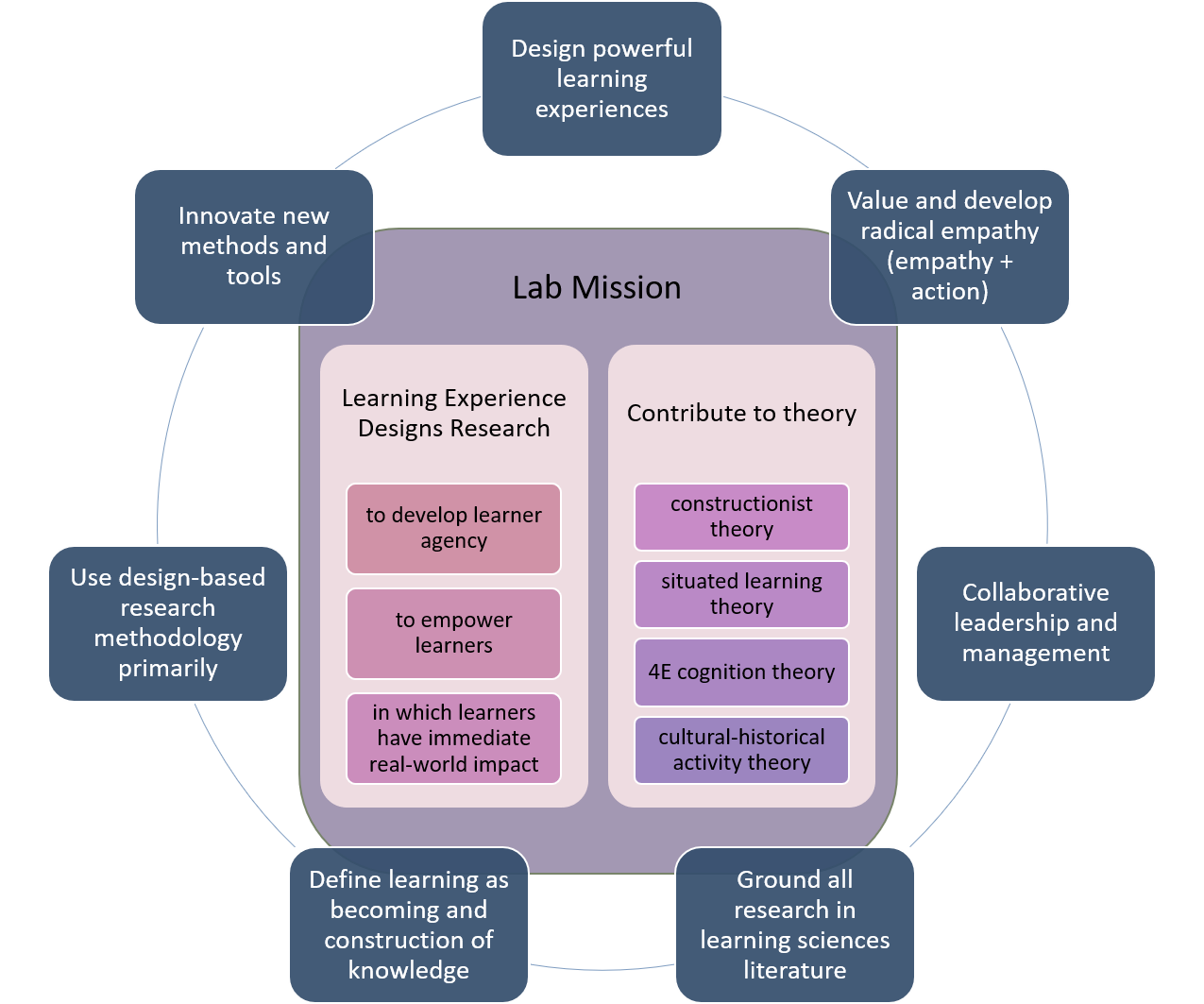
After developing the lab mission, the lab members worked together to develop a set of lab principles. Because the learning sciences can be described as a design science (Hoadley, 2018), the first principle states that all research conducted in the lab be research related to the design of powerful learning experiences.
The lab is led by Dr. Mahjabin Chowdhury and Dr. Kati L. Stoddard. The lab mission and principles were collaboratively developed by the members of the lab. The first element of the lab mission was that we will conduct research involving learning experience designs which develop learner agency, empower learners, and engage learners in activities with immediate real-world impact. The second element of the mission is that we will contribute to theory with a focus on constructionist theory, situated learning theory, 4E cognition theory, and cultural-historical activity theory.
The second principle emphasizes developing learner agency and empowering learners from underrepresented or marginalized communities through what we are calling “radical empathy” — empathy accompanied by action. This concept was inspired by Freire’s (1970/2005) definition of praxis as reflection and action in the world. The third principle describes designing affordances for learner agency (Withagen, de Poel, Araújo, & Pepping, 2012) by organizing the lab to be collaboratively led and managed by lab members, and that lab members would be co-equal collaborators in strategic planning, role negotiation and assignment, and research project planning. The fourth principle requires research be grounded primarily in learning sciences literature. The fifth principle defines learning as simultaneous processes of 1) becoming and 2) individual, collaborative, and collective construction of knowledge (Donaldson & Allen-Handy, 2020). The sixth principle incorporates design-based research methodology whenever possible (Barab, 2014). The seventh principle encourages fearlessness in innovating new data collection, generation, and analysis methods and tools (Kincheloe, 2005).
The lab members are now working on research projects, grant proposals, and developing faculty development workshops. In some of the research projects, lab members have started developing innovations in research methods, particularly in using network analysis in ways it has never been used before. Lab members have produced 35 conference papers, 7 peer-reviewed journal articles and book chapters, and 3 faculty development workshops. More importantly, we have seen all of the lab members developing skills in leadership, research design, data analysis, academic writing, communication, public speaking, collaboration, and creativity.